BEFORE YOU DECIDE SOMETHING IS WRONG WITH YOU, TAKE THE MEASUREMENTS
Something feels different. Maybe you don't have the patience you once had. Maybe something you used to enjoy has started feeling like another obligation. Maybe you're tired in a way that a good night's sleep doesn't seem to fix, or you're strangely relieved when certain plans are canceled. Or perhaps nothing dramatic has happened at all. Your life looks reasonably good from the outside, and you may even be grateful for much of it. It just doesn't feel quite the way it used to.
That's often where the interrogation begins. What's wrong with me? Why can't I just be happy? Why don't I have the motivation I used to have? Why am I so irritated? Why can't I handle this anymore?
Women are extraordinarily good at turning discomfort into a performance review. Tired becomes lazy. Resentful becomes ungrateful. Overwhelmed becomes disorganized. Restless becomes selfish. Before we've established what is actually happening, we've already decided who is to blame, and it's usually us.
Before you decide something is wrong with you, I'd like to suggest something much less dramatic: take the measurements.
What Does It Mean to "Take the Measurements" in Midlife?
In an actual fitting room, measurements are information. They don't tell us whether the garment is beautiful or whether we should keep it, and they certainly aren't a moral judgment about the body standing inside it. They tell us what is true today.
That's the idea behind what I call The Fitting. Before asking "What should I change?", we ask "What is true now?" The life that fit you ten or twenty years ago was built around a particular set of circumstances: your responsibilities, relationships, health, work, finances, energy, family, priorities, capacity and hopes. Some of those things may be exactly the same today, and some may be completely different. Some may never have fit particularly well at all, and you may simply have become extraordinarily good at compensating for them. That's why the first job isn't alteration. It's observation.
Midlife Can Involve Real Reevaluation
There is research behind the idea that midlife can involve meaningful reevaluation rather than simply decline. In a 1996 study published in Psychology and Aging, Eva Klohnen, Elizabeth Vandewater and Amy Young examined two longitudinal samples totaling 208 women. The researchers described midlife as a period that can involve reevaluation, reorientation, changes and turning points, and their work examined the psychological resources associated with successfully adapting to those changes.
That doesn't mean every woman experiences a dramatic midlife transformation, and it doesn't mean dissatisfaction proves you've "outgrown your life." It means change and reevaluation during these years are not inherently evidence that you've done something wrong.
Other research offers another useful perspective. Sociologist Deborah Carr analyzed 3,499 women from the Wisconsin Longitudinal Study to examine what happened when women's actual occupational achievements in midlife differed from the career aspirations they had reported earlier in life. Women who fell short of their earlier aspirations reported lower purpose in life and higher levels of depression, even after the researchers accounted for a number of other factors. That finding doesn't tell us why an individual woman's life looks different from the one she once imagined, and it certainly doesn't tell us she failed. But it does suggest something worth considering: the relationship between the life we expected and the life we're actually living can matter.
The Measurements May Have Changed
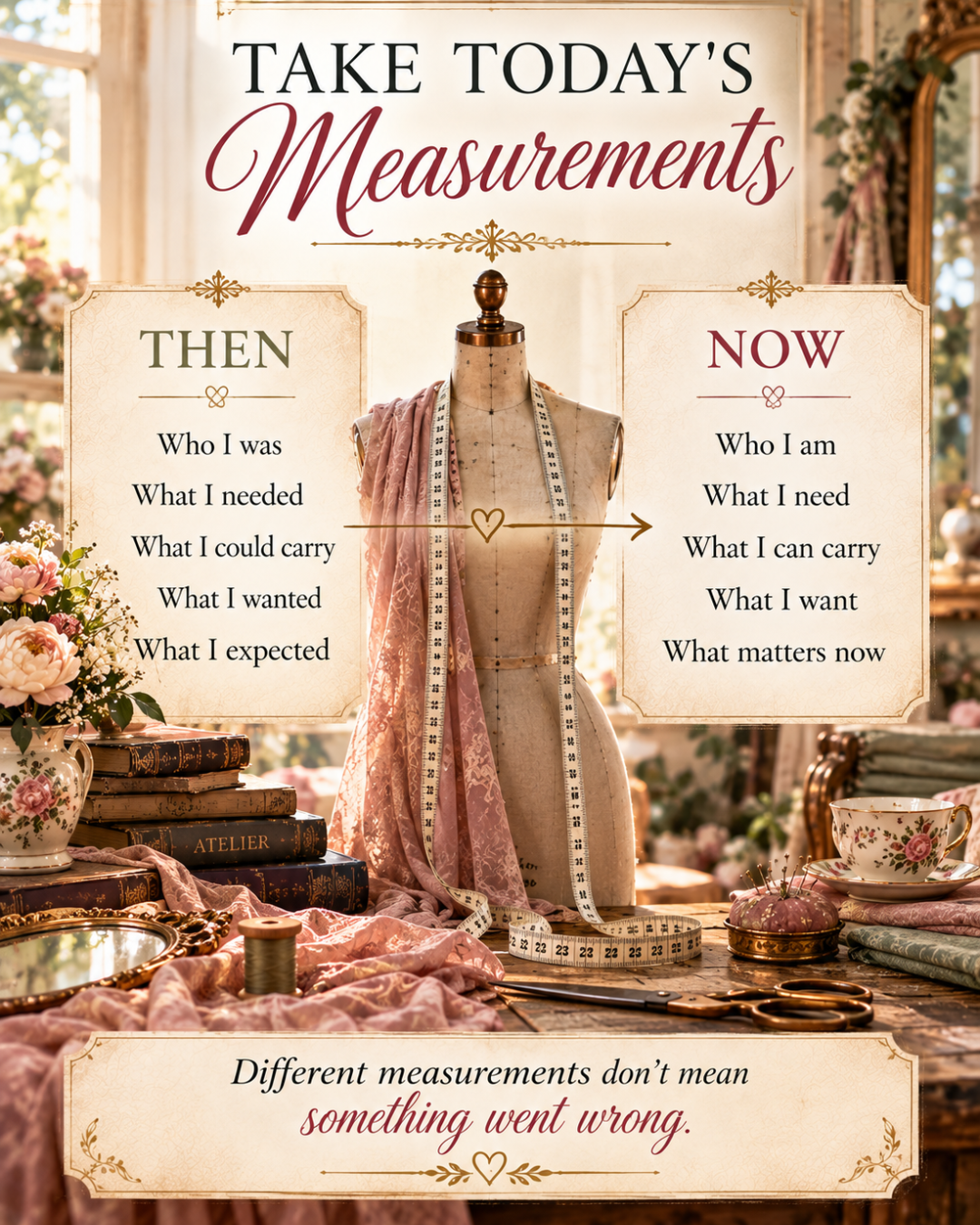
Think about yourself ten or twenty years ago. What did your life require from you? Who needed you? What were you trying to accomplish? What did success mean? What could your body comfortably handle, and how much recovery did you need? What were you willing to tolerate because something else mattered more? Now ask those same questions about today.
You may discover that the measurements changed. Perhaps your children need you differently now, or your parents need you more. Perhaps the career you once wanted no longer occupies the same place in your definition of a good life. Perhaps your energy or health changed, or your finances, or a relationship. Perhaps you changed. None of that automatically tells you what to do next. It simply tells you that using an old set of measurements to evaluate today's life may not be particularly useful.
Or Maybe It Always Pulled
There is another possibility: maybe the measurements didn't change. Maybe you've spent years adjusting yourself to make something work. Women can become remarkably skilled at compensation. We remember, organize, smooth things over, pick up what someone else forgot, and manage the emotional temperature of a room. We take on one more responsibility because it seems easier than asking someone else to do it. We become smaller, quieter, busier, more agreeable or more responsible because that's what keeps everything running. Eventually, being capable of carrying something can begin to look like evidence that carrying it is right.
It isn't necessarily. You can be exceptionally good at making something work and still ask whether it should require quite so much work from you. That question doesn't condemn the life you've built. It simply gives you better information about how it fits.
Friction Is Information, Not a Verdict
This distinction matters enormously. When something repeatedly pulls at the seams, that doesn't automatically mean it needs to go. Sometimes hard is simply hard. Caring for someone you love can be hard. So can marriage, parenting, meaningful work, learning something new, and grief. Difficulty alone is not evidence of poor fit.
But recurring friction can give us a place to investigate. If the same obligation repeatedly produces dread, resentment or exhaustion, or if you feel disproportionate relief every time it disappears from your calendar, that doesn't tell you what the answer is. It tells you where to look. A pulling seam tells a couturier where to investigate, not what alteration to make.
Sometimes the Problem Is the Load
We shouldn't turn every midlife difficulty into an individual woman's internal problem. Imagine you host Sunday dinner every week. You love having your family there, but you're also the person who plans the menu, shops, cleans the house, cooks, remembers everyone's preferences, sets the table, serves, clears everything and washes the dishes. Then one Sunday everyone cancels, and you're relieved.
Does that mean family dinner no longer fits your life? Not necessarily. Maybe family dinner fits beautifully, and doing every bit of the work doesn't. That's a completely different measurement. Before removing something from our lives, it's worth asking whether the thing itself is creating the friction, or whether the problem is the amount we're carrying around it.
And Sometimes It Isn't About "Fit" at All
Not every change in energy, mood, sleep, motivation or concentration is a message about your life's design. Bodies matter. Health matters. Hormonal changes, sleep, depression, anxiety and medication can all matter, and physical symptoms deserve appropriate medical attention when warranted. Sometimes what feels like "I don't recognize myself anymore" needs a conversation with a healthcare professional rather than an alteration to your life. And sometimes you're simply going through a difficult season that will eventually pass.
The point of taking the measurements isn't to make everything mean something. It's to stop deciding what something means before we've actually looked at it.
How to Take Today's Measurements
You don't need an elaborate life plan to begin. Choose one place in your life where you've noticed recurring friction, and work through these questions.
First, ask what still fits beautifully. Don't begin by assuming everything is wrong. What about this part of your life still matters to you? What gives you energy, meaning, connection or satisfaction? What would you want to protect even if other things changed?
Second, ask where it pulls, and be specific. Not "My job is terrible," but "I dread Sunday evening because Monday morning means three hours of meetings before I can begin the work I actually enjoy." Specificity gives you information.
Third, ask what changed. Consider your circumstances, responsibilities, health, relationships, capacity and priorities. Is something different now than when this originally worked?
Fourth, ask whether it was always pulling. How much have you been doing to make this work? Did it fit, or were you particularly good at accommodating it?
Fifth, ask whether this is hard or wrong for you, and don't rush it. Something difficult can still belong in your life. The question is whether the difficulty serves something that matters to you, or whether you're continually fighting against a fundamental mismatch.
Sixth, ask what you're not deciding yet. This may be the most important measurement of all. You are allowed to notice something before deciding what to do about it. Sometimes circumstances require immediate decisions, but when they don't, observation can come before action. You don't have to resign, leave, move, confront, reinvent or fix. Not yet. You can collect better information first.
The Fitting Comes Before the Alteration
Midlife doesn't automatically require reinvention, and that's one of the ideas I care most deeply about. Some lives need significant change. Others need a few thoughtful alterations. And some parts may fit more beautifully than we realized because we've been so focused on what's uncomfortable.
That's why we begin with a fitting. Not because every feeling contains a secret message, and not because every discomfort means you've outgrown your life. And certainly not because there's something wrong with you if the life you worked hard to build doesn't feel exactly the way it once did. We begin there because before we decide what needs changing, we should understand what is actually happening.
So if something has been pulling lately, don't begin with "What's wrong with me?" And don't begin with "What should I change?" Begin here: What is true today?
Take the measurements. Then we'll know what we're actually working with.
Research referenced
Klohnen, E. C., Vandewater, E. A., & Young, A. (1996). Negotiating the middle years: Ego-resiliency and successful midlife adjustment in women. Psychology and Aging, 11(3), 431–442. View the study record
Carr, D. (1997). The fulfillment of career dreams at midlife: Does it matter for women's mental health? Journal of Health and Social Behavior, 38(4), 331–344. View the study record