Why We Keep Trying to Live by Old Measurements
There comes a point in midlife when you may look at yourself and wonder why things that once felt manageable suddenly feel harder. You still have the same standards. You still care about your work, your family, your home, your plans. You still expect yourself to show up. So when you can't accomplish quite as much, recover quite as quickly, juggle quite as many things or maintain the pace you once did, it can be tempting to make the difference mean something about you. I'm getting lazy. I'm losing my drive. Why can't I handle this anymore? I used to be able to do so much more. Maybe you did. But before you decide you've somehow become less, there's another question worth asking: Were you living the same life then? Probably not.
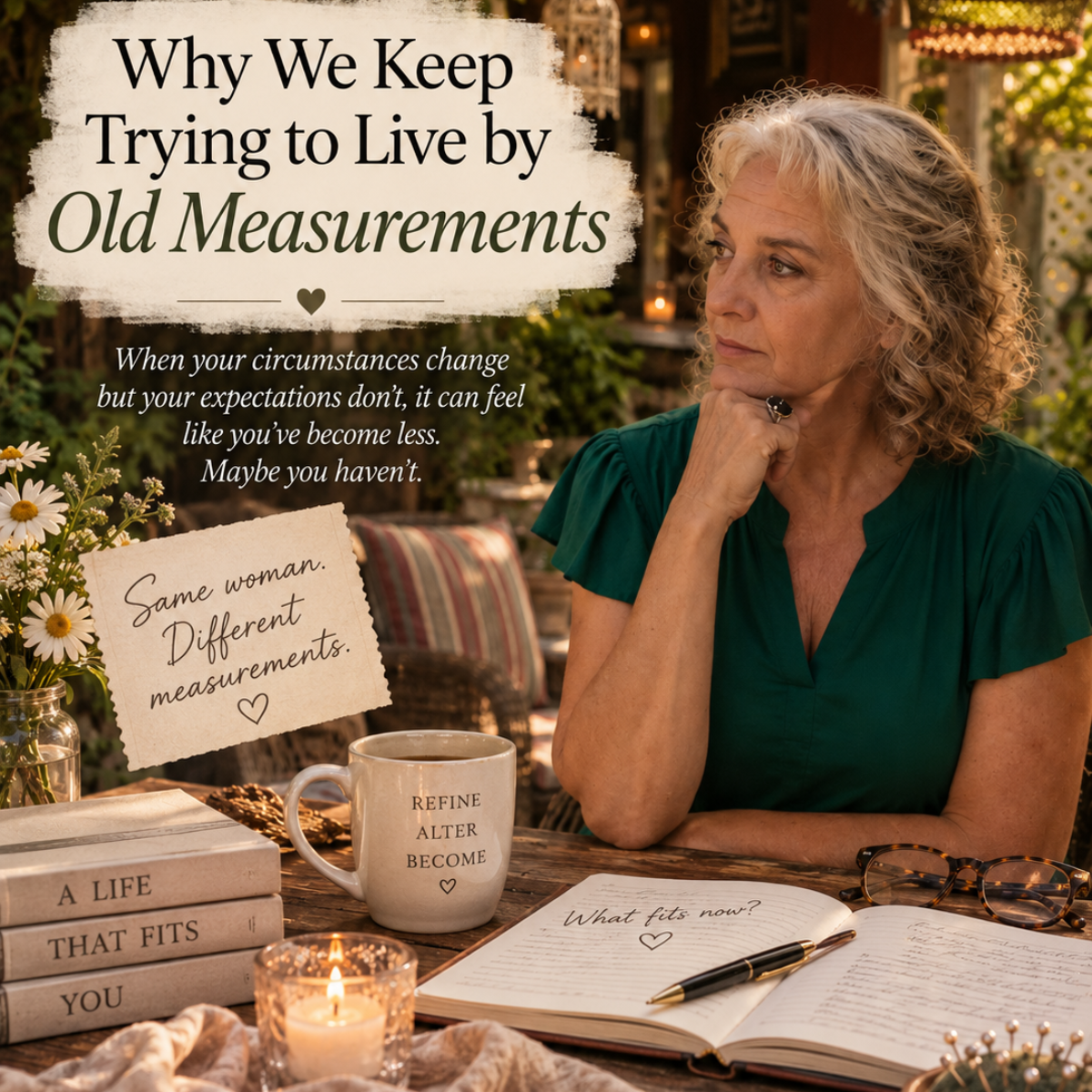
It's remarkably easy to compare ourselves with a woman who lived under completely different circumstances. We remember her energy. We remember her productivity. We remember how much she could accomplish before lunch. What we don't always remember quite as clearly is the life surrounding her. Perhaps your children needed you differently then. Maybe your parents didn't need you yet. Your work may have been different. Your marriage may have been different. Your finances, sleep, health or responsibilities may have changed.
And then there are the changes that happen inside a woman's body during midlife. Perimenopause and menopause can affect sleep, energy, concentration and mood. Aging itself changes things. So can illness, injury, grief, caregiving and years of accumulated responsibility. Sometimes there isn't one enormous event we can point to. Life simply changed. Yet we continue measuring ourselves against a version of ourselves who lived under circumstances that no longer exist. That's a fitting we're almost guaranteed to fail.
This is one distinction I wish more women heard. Capacity isn't character. Your current ability to carry something doesn't determine what kind of woman you are. Needing more rest doesn't make you lazy. Needing help doesn't erase your independence. Having less time doesn't mean you've lost your discipline. Accomplishing less during a demanding season doesn't mean you've lost your ambition.
But when you've spent decades being the dependable one, those distinctions can become surprisingly difficult to make. If part of your identity has been built around being capable, organized, productive or the person everyone can count on, a change in capacity can feel much bigger than a change in circumstances. It can feel personal. You aren't simply doing less. You begin to fear that you're becoming less. That's where we need to take another fitting.
Adjusting to the woman you are today does not require abandoning your standards. Standards tell us what matters. You may still want to do excellent work. Keep your commitments. Care well for the people you love. Build something meaningful. Continue learning. Take care of your home. Pursue the next chapter of your life. None of that has to disappear.
Expectations are different. Expectations say how you believe those things must be accomplished. I should be able to do all of this myself. I should be able to accomplish as much as I used to. I shouldn't need this much recovery time. I should be further along by now. Those expectations may have been written for an entirely different set of measurements. Updating them isn't the same thing as lowering your standards. Sometimes it's what allows you to keep your standards without exhausting yourself trying to meet them in a way that no longer fits.
There is another side to this, because I don't believe every uncomfortable feeling is evidence that we should do less. Sometimes we need to stretch. Sometimes we are procrastinating. Sometimes fear disguises itself remarkably well as this just doesn't fit me anymore. And sometimes what we need most is to stop thinking about the thing and get up and do it.
A tailor-fit life isn't a life with every difficult seam removed. It's a life designed honestly around who you are, what matters to you and the circumstances you're actually living in. There will still be places where you need to stretch. There will also be places where you need more room. Wisdom is learning the difference.
Instead of asking why you can't be the woman you were ten years ago, perhaps it's time to become curious about the woman standing here now. What are you expecting from yourself simply because you used to be able to do it? What has changed since then? Which expectations still serve you? Which ones belong to a season that has already ended? Where do you genuinely need to challenge yourself? And where are you turning a reasonable change in capacity into an accusation about your character? Those aren't questions designed to make your life smaller. They're designed to make it fit.
Because midlife isn't necessarily asking us to abandon the women we've been. Much of her is worth keeping. Her ambition. Her resilience. Her curiosity. Her experience. Her ability to begin again. But she doesn't have to keep squeezing herself into expectations tailored for an earlier version of her life. Same woman. Different measurements. Perhaps that's not decline at all. Perhaps it's simply time for another fitting.
Ready to take your own measurements?
The Fitting Room Journal is a free place to slow down and look honestly at what still fits, what has changed, and what you want to carry into your next chapter.
