When Life Changes Without Your Permission: How to Know What to Alter and What to Keep
There's a particular kind of change we don't talk about nearly as much as the change we choose. We talk about deciding to leave the job, start the business, move somewhere new, end the relationship, reinvent ourselves or finally pursue the thing we've been thinking about for years. Those changes can be frightening, but there is something reassuring about being the person who made the decision. You had a say.
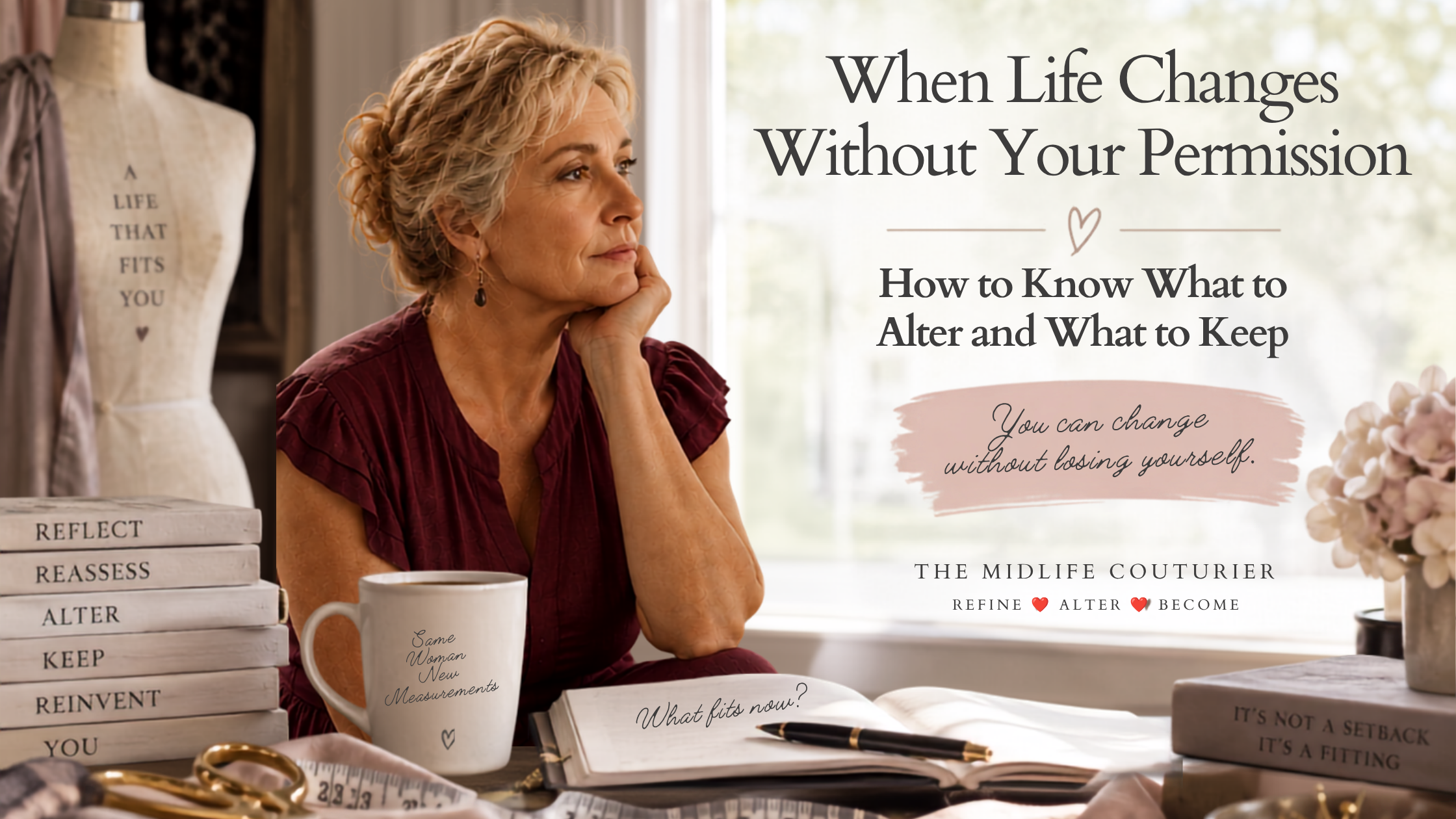
Unexpected change is different. Sometimes life changes one of the measurements before you've even realized you're standing in the fitting room. An illness arrives. Someone you love suddenly needs care. A relationship changes. Money becomes tighter than it was. A job disappears. Your body demands something different from you. An injury interrupts plans that seemed perfectly reasonable a week earlier. Nothing about the life you were building necessarily felt wrong. And yet, here you are.
One of the unsettling things about an unexpected disruption is how easily it can make the rest of your life feel uncertain. Something stops working the way it used to, and suddenly you start looking suspiciously at everything else. Do I need to change direction? Should I be doing something completely different? Was the life I was building wrong all along? Maybe. But probably not simply because something unexpected happened. This is where I think midlife women need to be particularly careful about the language of reinvention.
I believe in reinvention. Sometimes the old pattern truly cannot carry us into the next chapter, and we need the courage to admit it. There are marriages, careers, habits, identities, expectations and ways of living that we outgrow. But not every disruption requires reinvention. Sometimes one measurement changed, not the entire pattern.
When circumstances change, there can be an enormous temptation to solve the discomfort immediately. Instead, take a fitting. Start with what still fits. What still feels like you? What still matters to you? What parts of your life were working before this change arrived? What do you still want when you look beyond the immediate disruption? Those questions matter because upheaval can make perfectly good things look questionable simply because everything feels unsettled. If something still fits, you are allowed to keep it.
Then look at what genuinely needs attention. Perhaps your capacity has changed for a while. Maybe the schedule needs to loosen. You may need more help than you once did. A responsibility might need to be shared, postponed or released. Perhaps the change has revealed something that really wasn't working as well as you thought it was. That's where the alteration belongs.
This one can be difficult. Many of us have spent decades becoming very good at handling things. We take care of people. We make arrangements. We figure things out. We keep the wheels from falling off, often without anybody noticing how much work goes into keeping them attached. Then something happens to us. Our instinct may be to prove how little it affected us. We keep working. We find the workaround. We make another list. We push through the exhaustion and quietly congratulate ourselves for keeping everything running.
There can be strength in that. But there can also be avoidance. Being capable of functioning through something difficult doesn't mean it didn't affect you. You can be strong and need help. You can be resilient and tired. You can be grateful for what remains and still be angry about what changed. You can handle an unwanted alteration beautifully and wish with your whole heart that you never had to handle it at all. None of those things cancel each other out.
This may be where we make things unnecessarily hard on ourselves. Life changes, but our expectations remain exactly where we left them. We expect the same energy, productivity, patience, availability and capacity we had before the disruption. Then, when we cannot meet those expectations, we assume something is wrong with us. Perhaps the expectations are simply outdated. If the measurements changed, the pattern has to acknowledge them.
That doesn't mean lowering your expectations forever. It doesn't mean giving up on yourself or deciding that this difficult season is now your permanent identity. It means responding honestly to the life you are living today. There is a tremendous difference between giving up and adjusting.
When life changes unexpectedly, try resisting the urge to make sweeping decisions while everything still feels upside down. Instead, ask yourself a few quieter questions. What has actually changed? What still fits? What am I expecting from myself that no longer matches my present circumstances? What could be altered temporarily? What, if anything, has this disruption revealed that may need a more permanent change? And what do I absolutely want to carry with me when this season passes? You may discover that your life doesn't need reinventing at all. It may simply need a little room at the seams.
There's one more thing I think we should give ourselves permission to say. Some changes are lousy. We don't have to turn every hardship into a blessing. We don't need to find a lesson before we've even had time to understand what happened. And we certainly don't have to be grateful for something painful just to prove we're approaching it with the right attitude. Sometimes acceptance is much simpler than that. This happened. I wish it hadn't. Now, what fits? That is enough.
Because the goal isn't to pretend you wanted the alteration. The goal is to stop demanding that the old pattern fit circumstances that have already changed. Keep what still fits. Alter what doesn't. And if one day you realize the entire pattern really has become too small for the woman you are becoming, reinvention will still be there. But you don't have to throw away a perfectly good life simply because life changed one of the measurements. Sometimes the wisest thing we can do is take another fitting and begin there.
